What a Stale Cash Forecast Is Really Costing You
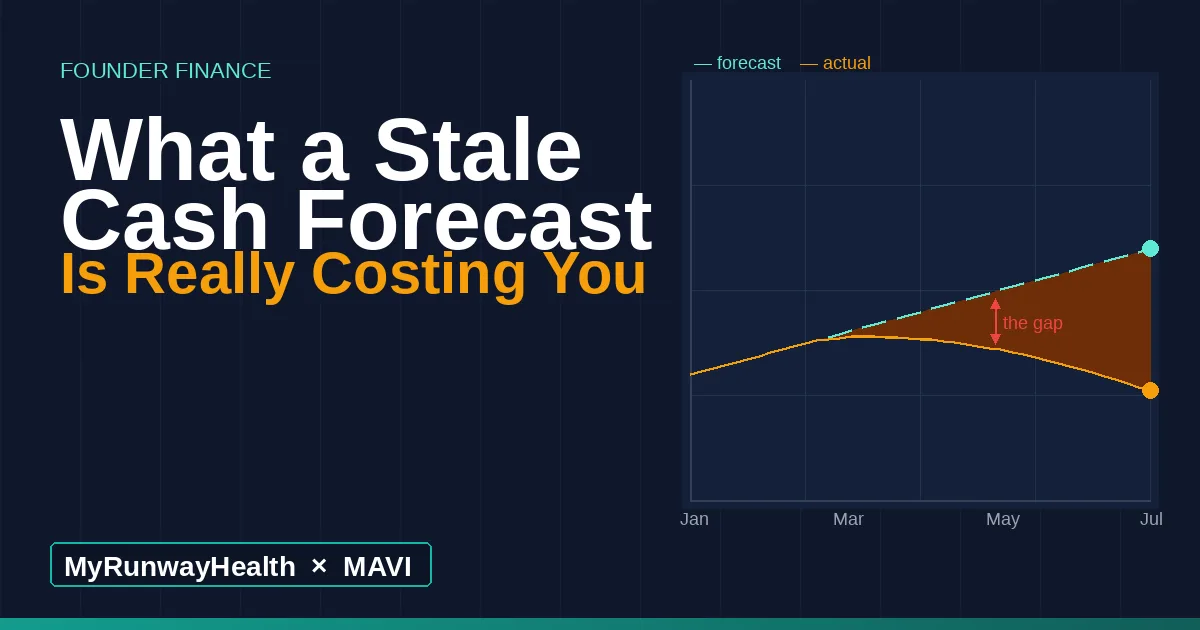
It's not just a data problem. It's a decision problem — and it compounds. Most founders discover their cash forecast was stale not because the numbers looked off, but because something went wrong that shouldn't have. Here's what it's really costing you.
(It's not just a data problem. It's a decision problem — and it compounds.)
The forecast that's never quite wrong
There's a particular kind of financial anxiety that doesn't announce itself.
It's not the moment you realize your runway is shorter than you thought. It's not the vendor payment that doesn't clear. It's subtler than that — it's the slow accumulation of decisions made on a cash forecast you knew wasn't quite right but trusted anyway, because nothing had gone catastrophically wrong yet.
Most founders we talk to don't discover their cash forecast was stale because the numbers looked off. They discover it because something went wrong that shouldn't have — a payroll surprise, a hiring decision that felt right until it didn't, a fundraising conversation that should've started six weeks earlier. The forecast wasn't obviously broken. It was just... close enough to believe.
That's what makes it dangerous.
A wildly wrong forecast is actually easy to deal with. You see it, you rebase, you adjust. The stale forecast — the one that's three weeks behind real data, or doesn't reflect a vendor contract that changed last month, or still assumes revenue timing from Q3 — that one is harder. It has the texture of truth. It's detailed enough to be convincing. It just isn't accurate.
And every decision made on it carries that inaccuracy forward.
What "stale" actually means
Before we talk about cost, it helps to get specific about what a stale cash forecast actually is — because "stale" is doing a lot of work in a lot of finance conversations right now.
A forecast goes stale when the assumptions baked into it no longer match reality, and nobody's updated them. This happens in predictable ways:
Revenue timing drift. You built the forecast assuming a contract closes in October. It slips to November. The forecast still says October, but you've been adjusting for it mentally. Until you don't. Each week you don't update it, you're working from a number that's confidently wrong.
Expense creep. A new SaaS tool got added. A contractor's hours went up. A one-time service fee became a recurring one. None of these are big individually. Collectively, they quietly widen the gap between what the forecast says you're spending and what you're actually spending.
Unreflected decisions. You made a hiring decision three weeks ago. That hire's salary, benefits, and equipment costs haven't made it into the model yet — or they're in a cell someone's updating manually, on a schedule that doesn't match how fast things are actually moving.
Disconnected data sources. The forecast lives in a spreadsheet. Your actual transactions live in QuickBooks. The person who usually reconciles them has been in back-to-back hiring screens for two weeks.
None of this is negligence. It's the operational reality of running a lean finance function in a growing company. But the cumulative effect is a forecast that looks authoritative and isn't.
The real cost — and why it's not the number you think
Here's the part that usually surprises founders: the cost of a stale cash forecast isn't primarily the bad decisions it causes. It's the good decisions you didn't make.
The bad decisions are visible, eventually. You overhired into a quarter that turned out to be slower than projected. You pushed a vendor negotiation past the point of leverage. These show up, you learn, you adjust.
The invisible cost is the confident decisions you made on bad data — and never found out were wrong, because the outcome was neutral. You almost hired someone senior. You almost extended a contract. You almost passed on a piece of equipment that would've saved you time. The forecast said you had runway; you moved forward; it worked out. But it worked out because of factors that had nothing to do with the forecast.
The stale forecast didn't hurt you that time. It just didn't help you. And over time, the accumulated effect of decisions made on bad data — even when those individual decisions happen to turn out okay — is a slower, less confident business than you should have built.
There's also a compounding effect that's worth naming explicitly. Cash forecasting is a sequential decision chain. Decision A affects the conditions under which you make Decision B. If A was made on stale data, the conditions you're now modeling for B are already off. By the time you're making Decision C, you're three steps removed from reality and the gap is invisible in your model.
"The first thing our candidates usually flag in the first few weeks isn't a glaring error – it's a quiet disconnect. The forecast says one thing, the bank reconciliation says another, and nobody's quite sure when the gap opened. Before they can do any forward-looking work, they're tracing back through months of transactions to find where the model and reality diverged. It's the most common version of 'the books look fine' that we see."
— MAVI
The specific scenarios where stale forecasts bite hardest
We've worked with early-stage founders and small business owners, and the growing number of finance people who support them — and the scenarios where a stale cash forecast does the most damage cluster pretty consistently.
Fundraising timing. The most expensive version of a stale forecast is the one that tells you fundraising isn't urgent yet. The second most is the version that says you need to raise more than you actually do. The right time to start a fundraising conversation is almost always two months before you think it is. If your forecast is three weeks stale and already optimistic, you might be looking at a four-to-six week window you thought was eight.
Hiring decisions. Growth-stage hiring is expensive, and the cost usually stretches further than founders plan for — especially when you factor in ramp time, equipment, benefits, and the management overhead of bringing someone new in. In a small business, it's even worse because the growth usually doesn't have the same 'hockey stick' that a startup does. If your forecast is built on revenue assumptions that are a quarter behind, the new hire looks a lot safer than they are.
Vendor negotiations. Cash flow position is leverage in negotiation. If your forecast says you have comfortable runway and your actual position is tighter, you negotiate from the wrong chair. Not dramatically wrong — subtly wrong. And subtly wrong in a negotiation compounds quietly over the life of a vendor relationship. And if it's reversed? You likely just gave up a couple of percentage points because you didn't know how much leverage you actually had.
Customer investment decisions. This one surprises people. When you're deciding which customer segments to invest more sales and success effort in, you're making an implicit bet about how much cash that investment will require before it pays back. A stale forecast changes the risk profile of those bets without changing how they feel.
The talent loop: why good people can't fix this alone
This is the part of the stale-forecast problem we don't talk about enough — and where the connection to your finance function becomes hard to ignore.
A skilled accounting hire or fractional CFO walks into a company and immediately starts doing one thing: figuring out where the numbers actually are. Not where the forecast says they are. Where they actually are. That reconciliation work — pulling transactions, verifying assumptions, tracing the gap between what the model says and what the bank shows — that's the job in the first 60 days.
It's important work. But it's not the forward-looking work you hired them for.
The compounding problem is this: a company without a strong accounting function tends to let its data lag. That lag is what creates the stale forecast problem. So when you finally do get the right finance talent in the room, they spend their first two months cleaning up the foundation before they can do any of the structural work. The stale data and the talent gap are the same problem wearing different hats.
"What we hear most often from candidates in their first month is some version of: 'I came in to build the forecast and ended up rebuilding the foundation first.' The close process was running behind, assumptions hadn't been updated in a quarter, and the data feeding the model wasn't reconciled to actuals. They're doing important work – but it's archaeology before it's architecture. The companies that get the most out of a strong finance hire are the ones that come in with clean, current data so the hire can start building on day one instead of cleaning up from day one."
— MAVI
The companies that get this right tend to invest in both simultaneously. They're not waiting to get the data clean before hiring the finance person, or waiting to hire the finance person before cleaning up the data. They're doing both at once, because each accelerates the other.
What "current" actually looks like in practice
We want to be direct here: a current cash forecast doesn't mean a perfect one. It means one you can defend.
A few working principles we've seen hold across different company types and stages:
The 48-hour rule. If you can't reconstruct your current cash position — not a forecast, just current cash — in 48 hours from scratch, your data infrastructure has a problem that no amount of forecasting will fix. Current cash should be a five-minute pull, not a project.
Assumption dating. Every assumption in your forecast should have a date. When was revenue timing last verified? When was the payroll number last updated? When did you last confirm the contract close is still on track? Undated assumptions are the primary vector for stale forecasts in lean finance teams.
Scenario-forward, not backward-accurate. The goal of a forecast isn't to be right about last month. It's to be useful about next quarter. The best forecasts we see are slightly loose on historical precision and very tight on scenario modeling — because the question you're actually trying to answer is always a forward-looking one.
The connection point between your tools and your team. If your cash forecast lives in a spreadsheet that requires a human to update it from a separate system, the forecast will always lag the reality by exactly as long as it takes that human to get back to it. The companies that maintain accurate forecasts have either automated that connection or built a habit around it tight enough to be effectively automated.
Common questions we hear on this
If my business is doing okay, does forecast accuracy really matter that much?
Yes — and this is the core of the "things are worse than you think" problem. A stale forecast in a healthy business feels fine right up until a decision gets made that closes off an option you didn't know you had. The cost of inaccuracy in a good quarter is invisible. The cost in a bad one is catastrophic.
We switched from QuickBooks to Puzzle/Rillet/Campfire — doesn't that mean our data is current?
Just like QuickBooks, those are accounting systems — your General Ledger. They tell you where the money went. In the more modern cases, the zero-day-close is a real thing. But the cash forecast tells you where it's going. These are interconnected but not the same — and the translation between them is where most forecast staleness lives.
How often should we be updating the forecast?
For most companies in the $1M–$10M range, a weekly reconciliation of actuals against forecast is the right cadence. Monthly is better than quarterly. The goal isn't daily obsession — it's a rhythm that's tight enough that you're never more than a week from knowing where you actually stand. And if you're still doing it manually, it has to fit into the long list of other things vying for your attention. If you have an automated solution (like MyRunwayHealth), the time and accuracy burden drops exponentially.
What's the difference between a cash forecast and a budget?
A budget is a plan. A cash forecast is what's actually going to happen to your cash. Think of it as strategic (budget) vs. tactical (forecast). They should inform each other, but they're not the same document, and treating them as interchangeable is one of the most common — and most expensive — accounting mistakes we see in growing companies.
The bottom line
The stale cash forecast isn't a reporting problem. It's a decision quality problem, and the decisions it degrades are usually the most consequential ones — the timing calls, the hiring bets, the fundraising windows.
The good news is that it's fixable, and the fix is actually less about technology than it is about habit. Current data requires regular investment. Not a big investment, but a consistent one. But if you're never reviewing it, then it doesn't matter how good — or how current — your data is.
The right accounting function and the right financial tools are both part of that investment — and they're most effective when they're working together, not waiting on each other.
MyRunwayHealth gives early-stage founders and finance teams real-time cash flow visibility and scenario modeling — the tools that keep your forecast current. Start your free 7-day trial →
MAVI connects growth-stage companies with accounting and finance talent — the people who know what to do with the data once it's clean. Talk to MAVI about your next hire →